
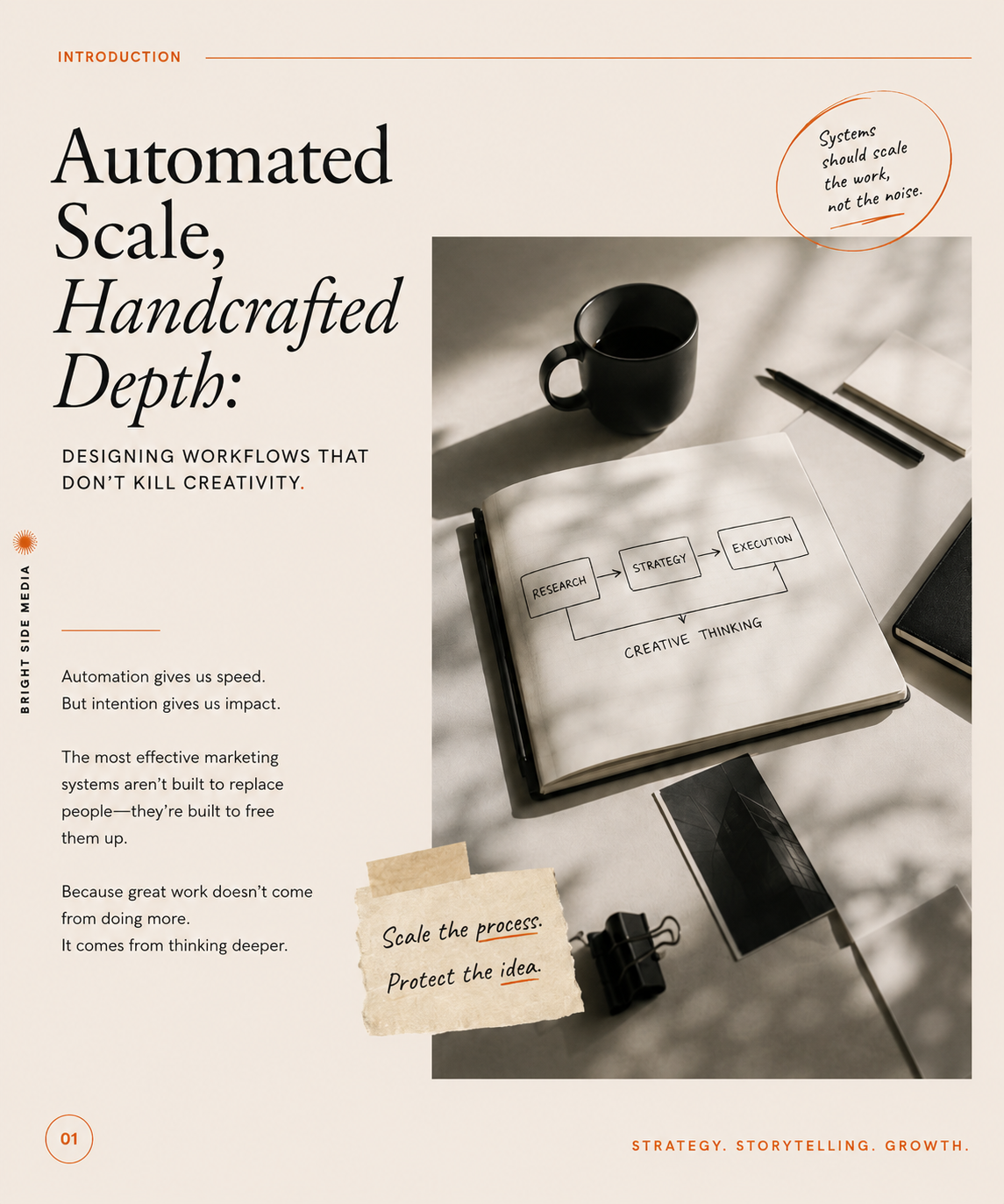
Automated Scale, Handcrafted Depth: Designing Workflows That Don't Kill Creativity.
When the marginal cost of producing a digital asset drops to absolute zero, the economic value of raw production volume collapses alongside it. The competitive field shifts entirely from generation to curation.
We live in a marketplace flooded with algorithmically smooth, infinitely generated code, design, and copy. Because the barrier to entry has evaporated, brands that rely solely on raw automation pipeline generation are discovering an uncomfortable truth: they are manufacturing their own invisibility. The real problem isn't that AI outputs lack polish—it's that they lack gravity.
The Illusion of Speed: Asset Proliferation vs. Distinct Architecture
Many technology teams make the strategic mistake of optimizing workflows purely for transactional velocity. They build complex pipelines that generate thousands of ad variations, web interfaces, or technical documentation logs with zero manual sign-off. The result is a profound homogenization of the product experience.
To maintain an exceptional market position, automation systems must be designed as multipliers for human execution density, not replacements for the human curatorial layer.
| Operational Layer | The Automated Factory | The Handcrafted Leverage Model |
|---|---|---|
| System Architecture | Direct programmatic deployment from model variables to live codebase. | Decoupled execution engines with isolated human approval check-loops. |
| Design Philosophy | Averaged global styling patterns using strict template models. | Bespoke typographic layout exceptions designed over structural system grids. |
| Competitive Moat | Easily bypassed by any competitor using a comparable generation engine. | High cognitive friction to replicate the distinct editorial taste layer. |
The mathematical formula behind long-term product distinction relies heavily on this relationship: raw automated throughput only delivers real market value when combined with structural intent.
The Leverage Formula: Modeling Effective Creative Quality
To isolate how automation scales output without actively degrading brand value, corporate architecture teams utilize an intentional equation to measure effective output quality:
Raw volume is non-linear. If the structural human curation coefficient approaches zero, the value signature decays toward absolute market irrelevance, regardless of automated velocity.
• Oc = Effective creative distinctiveness delivered to the market
• V = Volume of production assets handled by automated infrastructure
• E = Baseline generation efficiency coefficient
• Ck = Human curatorial filter density scaled by sensitivity constant k
Engineering the Hybrid Studio Stack
Decouple Generation From Assembly
Never route model generation outputs directly into external runtime layers. Build isolated sandbox environments where raw programmatic layouts, functions, and text elements are held for intermediate analysis.
Codify the Aesthetic Quality Controls
Translate the core visual guidelines of the asset into strict system configurations. Build tests that explicitly check for systemic generic patterns, broken layouts, and repetitive syntactical configurations before any manual verification stage.
Inject Bespoke Structural Asymmetry
Empower engineering and design leads to break grid conventions intentionally. Force custom spacing offsets, distinct font treatments, or unexpected design micro-interactions over standard automated layouts to give interfaces real human presence.
Continuously Refine the Training Foundations
Use your unique, human-curated adjustments to fine-tune local models. By capturing original, asymmetric decisions, your system infrastructure learns to generate outputs matching your specific taste baseline over time.
True systems maturity means knowing exactly when to let the pipeline run at maximum velocity, and exactly when to intervene with meticulous human precision. Automation handles the baseline structural architecture; human intentionality crafts the memorable depth.